China: An execution by the 'Death of a Thousand Cuts' (1884).
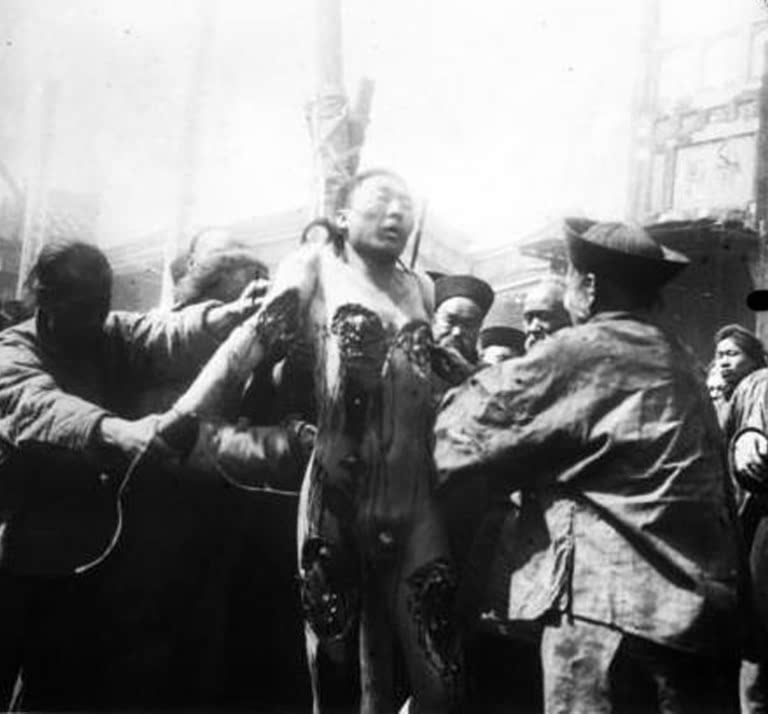
'Slow slicing' (pinyin: língchí, alternately transliterated Ling Chi or Leng T'che), also translated as the slow process, the lingering death, or death by a thousand cuts, was a form of execution used in China from roughly 900 CE until its abolition in 1905. In this form of execution, the condemned person was killed by using a knife to methodically remove portions of the body over an extended period of time. The term língchí derives from a classical description of ascending a mountain slowly.
Lingchi was reserved for crimes viewed as especially severe, such as treason and killing one's parents. The process involved tying the person to be executed to a wooden frame, usually in a public place. The flesh was then cut from the body in multiple slices in a process that was not specified in detail in Chinese law and therefore most likely varied. In later times, opium was sometimes administered either as an act of mercy or as a way of preventing fainting. The punishment worked on three levels: as a form of public humiliation, as a slow and lingering death, and as a punishment after death. The latter as to be cut to pieces meant that the body of the victim would not be 'whole' in a spiritual life after death.
ID
AKG3805567ProductionDate
2015-07-02Credit line
akg-images / Pictures From HistoryCollection
Pictures From History
Catégorie
Histoire et politique
Période
9e siècle
1er millénaire
Sujet
Torture
Histoire
Exécution capitale
Punition
Crime
Lieu
Asie
High
4400 × 4088 (51.5 MB)
37.3 cm × 34.6 cm @ 300 dpi